


Summary
Students regularly face unexpected financial disruptions—a rent increase, a car repair, a surprise medical bill—that their financial aid packages were never designed to cover, and many have little margin to absorb them. Emergency aid, often in modest amounts of $500 to $1,000, is a promising way to keep these financial shocks from pushing students out of school. Federal support during the pandemic, through the Higher Education Emergency Relief Fund (HEERF) demonstrated that emergency aid can act as a powerful safety net when it is funded at scale. But since HEERF expired, the availability of emergency aid has contracted sharply: the share of students reporting they received emergency aid fell from 44% in fall 2021 to just 4% in fall 2025. That contraction comes even as rates of basic needs insecurity continue to grow, and as cuts from the One Big Beautiful Bill Act make the public benefits and financial aid students rely on harder to access.
In the absence of sustained federal support, a growing number of states have stepped in. This report summarizes and details key features of statewide emergency aid programs in California, Michigan, Minnesota, North Carolina, Tennessee, Virginia, and Washington, examining how each approaches eligibility, allowable uses and award amounts, application processes, and reporting.
Drawing on these promising models, we recommend that states considering new investment in emergency aid programs design them in ways that minimize barriers to entry, conduct proactive outreach, embed emergency aid within existing student support systems, take full advantage of emergency aid's exclusion from "other financial assistance," allow broad and flexible uses, and collect meaningful data to continuously reassess students' needs.
State emergency aid can and must also be augmented through sustained federal support, and Congress has tools at its disposal to ensure that no student needs to make the difficult decision to leave school because of a sudden financial hurdle. Lawmakers should restore flexibility allowing the campus-based Supplemental Education Opportunity Grant (SEOG) to function as emergency aid, create a permanent emergency aid program modeled on HEERF, and invest in holistic campus basic needs supports to provide students with all the supports for which they may be eligible. When funded consistently and designed with students' actual experiences in mind, emergency aid can ensure that a sudden hurdle does not become a permanent barrier to completing college.
Introduction
Students—just like all of us—regularly face unexpected financial disruptions in their daily lives, including surprise utility and medical bills, rent increases, car repairs, or even a laptop or phone on the fritz. Unfortunately, because students’ financial aid packages are determined well in advance of their quarter or semester, they often have few resources at their disposal to cover these sudden costs.
The financial burden can quickly become a crisis that existing grants, scholarships, or loans ignore entirely. The options available to students at these moments are often painful, if they exist at all. Picking up extra hours of work undermines their academic success; short-term and private loans carry opaque, predatory terms, credit risks, and accelerated repayment timelines; and seeking additional federal financial aid is complex and time-consuming, with no guarantee of relief.
Students often lack the financial means to absorb even a financial shock some would consider modest. According to Trellis Strategies’ Student Financial Wellness Survey, 54 percent of undergraduates reported they would have trouble coming up with $500 in cash or credit to meet an unexpected need within the next month.1 This financial fragility is even more pronounced among parenting students and first-generation students—students who traditionally have less financial margin for error and more family obligations. Among single parenting students specifically, 81 percent said they would have trouble obtaining $500 in an emergency. Nearly two-thirds (65%) of students indicated they had run out of money at least once since the start of the year, with 21% running out of money eight or more times, a dynamic that leaves no room for additional unexpected costs.2

Source: Trellis Strategies, Student Financial Wellness Survey
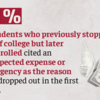
Too often, these emergencies simply push students out of school. The Hope Center’s Student Basic Needs Survey finds that, among students who previously stopped out of college but later re-enrolled, nearly one-third (31%) cited an unexpected expense or emergency as the reason they dropped out in the first place, and over one-third (34%) cited insufficient money for living expenses as the reason for originally leaving.3
Research increasingly confirms that providing emergency aid (sometimes known as “emergency grants” or “emergency financial assistance”), often in smaller amounts ranging from $500 to $1,000, is a promising strategy to complement underlying need-based financial aid for budgeted educational expenses to address acute basic needs crises facing students. When delivered on time and in sufficient amounts, students can use the funds for urgent essentials and remain on track in their degree program. Emergency aid also provides a particular financial advantage for students over other forms of financial assistance, as the recipients of the aid do not have to worry about other grants or scholarships being “offset” or deducted from their financial aid package.
Over the past two decades, many institutions of higher education have developed their own, limited emergency aid programs, funded through operating funds, philanthropic support, or other sources.
Source: The Hope Center Student Basic Needs Survey
In the midst of the COVID-19 pandemic, Congress, in a bipartisan manner, funded the first-ever federal investment in emergency aid through the Higher Education Emergency Relief Fund (HEERF), which doled out more than $30 billion in total over three rounds of funding for the express purpose of emergency grant aid to students.4 HEERF emergency aid was largely available to all enrolled students, and could cover any unexpected expense related to a student’s cost of attendance (COA), with greater flexibility and fewer conditions than traditional grant aid.
Students largely used these grants on basic essentials, as expected: one foundational analysis revealed that 61% used funds to purchase food and 50% used funds for housing.5 An earlier pandemic-era survey from The Hope Center also found that over two-thirds (70%) of emergency aid recipients said it helped them stay enrolled, and 76% said it reduced their stress.6 Other studies have found that students who received HEERF emergency grants were more likely to stay enrolled the following term and graduate compared to students who did not receive emergency grants.7
Unfortunately, the availability of emergency aid has contracted sharply since the pandemic.8 Data from Trellis show that the share of students reporting they received emergency aid dropped from 44% in fall 2021—when HEERF funding was widely available—to just 6% in fall 2023 and 4% in fall 2025.9
The need, however, remains as strong as ever. New federal data following students who entered college in 2019–20 (BPS:20/22) confirm that basic needs insecurity is not a temporary disruption that fades as students settle into college: two years into their enrollment, nearly one in three students still enrolled (31.6%) experienced food insecurity, housing insecurity, or homelessness, and more than 4-in-10 (43%) of those who began college food insecure were still food insecure.10 When hardship follows students throughout their college years, the need for emergency support becomes a consistent factor in determining whether they can persist and graduate.
While colleges and universities across the country have maintained the infrastructure and continue to operate their own emergency aid programs, demand for emergency grants now far outpaces the availability of funds.
The One Big Beautiful Bill Act (OBBBA), signed into law in July 2025, enacted roughly $186 billion in SNAP cuts and nearly $990 billion in Medicaid cuts through 2035. The bill limits the ability of future SNAP benefits to keep pace with inflation, includes new restrictions and work reporting requirements for older Americans and parents, and new bureaucratic hurdles for families and students (especially those attending less-than-half-time). It also shifts massive new costs onto already-strained state budgets, threatening funding for public higher education, student services, and state financial aid. As a result, it will be markedly harder for low-income students to access the public benefits and financial aid that could help them avoid emergencies and stay on track.

Emergency aid, when funded consistently and systemically, can act as a bulwark against macroeconomic conditions and ease the pain of the potential loss of other supports, while providing some form of insurance against unexpected future costs that will no doubt continue to affect students.
In the pages that follow, we profile the seven states that have built statewide emergency aid programs since the pandemic, identify the design choices that most shape whether those programs reach students in need, and offer recommendations for states (and the federal government) to turn emergency aid from a stopgap into a durable part of the student safety net.
Footnotes:
[1] Fletcher, C., Cornett, A., Plumb, M. H., Schuette, A., Mentzer, L., & Ashton, B. (2026). Student financial wellness survey: Fall 2025 results. Trellis Strategies.
[2] Ibid
[3] The Hope Center for Student Basic Needs. (2025). The Hope Center 2023–2024 student basic needs survey report. Temple University.
[4] U.S. Department of Education. (n.d.). Higher Education Emergency Relief Fund (HEERF). Among funds awarded for higher education relief under CARES, CRRSA, and ARP, $30 billion was allocated to student emergency grants primarily to public and private non-profit colleges, with another $836 million allocated to emergency grants for Proprietary Institutions Grant Funds.
[5] NASFAA, NASPA, and HCM Strategists. (2022, October). Evaluating student and institutional experiences with HEERF.
[6] The Hope Center for Student Basic Needs. (2021). Hope Center survey report 2021: Basic Needs Insecurity During the Ongoing Pandemic.
[7] Center for Higher Education Policy and Practice. (2023). Does basic needs funding improve persistence among college students?; WGU Labs. (2023, August 31). "No strings attached" financial aid from HEERF III shows 11.2% boost in graduation rates for low-income students.
[8] Kara, Muhammad. (2026, July 16). The safety net is gone: More emergency aid programs, but fewer students reached. The Hope Center for Student Basic Needs.
[9] Trellis Strategies. (2026). Emergency aid in the wake of the pandemic.
[10] Kara, Muhammad. (2026, June 11). New longitudinal federal data reveal a troubling reality: Students’ basic needs insecurity persists. The Hope Center for Student Basic Needs.
[11] Huelsman, Mark (2025). The looming utilities crisis facing students, and what we can do about it. The Hope Center for Student Basic Needs.
[12] The Hope Center for Student Basic Needs. (2025). The impact of OBBBA on student basic needs security [Webinar].