

While states face substantial financial barriers in funding emergency aid programs to the scale of the need, there are several design and delivery principles that undergird the most promising and successful efforts at meeting students’ needs. In particular, state programs that are easily communicable and reduce red tape and confusion—both on the front end for students and the back-end for administrators—are more likely to fulfill program goals, while remaining nimble to the changing needs of students each semester or year.
Minimize Barriers to Entry
In order to maximize impact, emergency aid programs should be designed with the fewest possible eligibility restrictions. Requirements such as completing the FAFSA, meeting satisfactory academic progress (SAP), enrolling full-time, or meeting minimum credit thresholds may seem reasonable on paper to some, but can easily screen out the very students who need help most to remain enrolled.
Students struggling to navigate—or who do not qualify for—one complex system (financial aid) may be less likely or apt to go through the process of navigating another institutional system (emergency aid), especially during moments of financial and emotional stress.
Washington's SEAG program offers a model for other programs: it relies on a simple application with minimal initial eligibility criteria and encourages institutions to trust students who submit requests. States should carefully evaluate every eligibility criterion to confirm which are designed to facilitate aid and disburse funds equitably, which are useful in improving the program over time, which are important for compliance purposes, and which present undue barriers on students and administrators alike. Where restrictions are deemed necessary, potentially due to a small pot of funds, they should be as clearly justified as possible and simply communicated.
Most importantly, programs should aim for continuous improvement by actively monitoring whether certain populations are being disproportionately excluded or being tripped up in the process of obtaining support so that future rounds may account for students who are inadvertently left behind. For example, a program theoretically designed to reach students whose families utilize public benefits, or Pell Grant recipients, may seem “targeted” and easily communicated. However, these targeted populations can be affected by policy change. With an expected net loss of benefits among families as a result of OBBBA in the coming years, a state may want to reconsider eligibility criteria tied to public benefit receipt to account for those with substantial need who no longer qualify for other programs.
Establish a Clear Application Process with Proactive Outreach
Students cannot access emergency aid if they do not know it exists or cannot figure out how to apply. In nationally representative data, more than two-thirds of enrolled students (69%) said they had no idea whether their campus even offered emergency aid.1 And among students already experiencing food insecurity, housing insecurity, or homelessness, the rates were no better—67% of those struggling students were unaware.
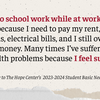
Programs should establish a straightforward application process that is clearly publicized across multiple channels (including institutions’ and state higher education agency websites, orientation materials, and financial aid documents). Among students experiencing food or housing insecurity in The Hope Center's 2023–24 Student Basic Needs Survey, 87% said they would like their college to reach out about available supports by email, 38% by text, and 25% through the learning management system.2
And the emergency programs should invest in outreach—particularly during moments of widespread financial stress. For example, the Trump Administration’s initial decision during the November 2025 government shutdown to withhold SNAP benefits3 created an acute and predictable spike in food insecurity for students across the country; programs that had proactive outreach strategies in place were better positioned to reach affected students quickly.
Where at all possible, institutions should make emergency aid feel like a normal, accessible part of the student support ecosystem rather than a last resort that requires students to be in the right place at the right time. Outreach should extend beyond the financial aid office, or one-time efforts, and be embedded among faculty, instructional, and advising staff, who are often the first to notice when a student is struggling, and institutions should make information about emergency aid a standard part of every financial aid and basic needs interaction.
In a 2025 survey by the National Association of Student Financial Aid Administrators (NASFAA), more than half of financial aid offices reported resource shortages serious enough to degrade service during peak periods (38% moderate, 14% severe), and the functions they named as most affected by these shortages are the ones that connect students to aid: outreach, maintenance of the aid office website, and work targeted to specific student populations.4 Financial aid offices cannot be the only ones involved in conducting outreach.
Given that the data from existing programs consistently shows that non-tuition costs are the primary driver of requests (including housing, food, and transportation), states should also require institutions to list the potential availability of emergency aid at key touch points when students apply for housing, meal plans, visit campus pantries or stores, meet with advisors, or interact with financial aid offices (both at the beginning of a semester and when students apply for a Professional Judgment to appeal and adjust their financial aid package), and more.
Finally, when eligibility rules or allowable uses change, programs should communicate those changes clearly and prominently. North Carolina’s Finish Line Grants FAQ offers a useful model, explicitly flagging and highlighting new requirements as well as those from prior years that no longer apply.
Embed Emergency Aid into Student Support Systems
Emergency aid should be woven directly into the systems institutions already use to identify and support struggling students, rather than as a standalone program that exists outside of the typical student services infrastructure. For example, institutions often employ early alert or warning systems that can flag students for proactive outreach and support when their grades decline or they are at risk of dropping out, with support often taking the form of advising or student success coaching. These programs can and should include standard prompts about the likelihood of unexpected financial hardship and information about how to access emergency aid. Similarly, campus basic needs navigators or benefits-screening referrals should also route students to the application for emergency grants alongside the paperwork needed to enroll in SNAP, housing, and child care resources.
States should also create guidelines that emphasize providing support rather than creating reasons to deny students help. Programs should be explicit that when students come to emergency aid program staff with repeated requests, the goal should be to escalate their case to financial aid or student services for more durable support, especially if they cannot receive additional emergency grants. States should be explicit in their guidance that a pattern of repeated requests—from individual students, from students at specific times of the academic year, or from particular groups of students—is not a sign the student is doing something wrong, but a signal to build out additional support services and sustained interventions.
Finally, faculty should be encouraged to include brief, standardized syllabus language pointing students to emergency aid, basic needs centers, and resources like food pantries. States should work with faculty and staff unions and other associations to create best practices around methods, materials, and modes of communication that can help inform outreach and advocacy. By embedding emergency aid in these existing touch points, campuses and states can reach students who would never think to ask for support or would only do so after bills are long overdue, and reinforces the normalcy of interacting with the support ecosystem.
Maximize Emergency Aid's Unique Exclusion from "Other Financial Assistance"
For many years, emergency aid fell into a persistently confusing trap in financial aid policy: giving money to students in crisis often resulted in the college having to take away money from the student somewhere else in their financial aid package, leaving them no better off. This caused many states and institutions to downplay the importance of emergency aid, underfund it, or push it outside of the financial aid office entirely.
The source of this trap was the federal formula. Grants and scholarships awarded outside the federal financial aid programs, including private scholarships, state grants, and institutional aid, are generally treated as Other Financial Assistance (OFA) and must be factored into a student’s total package, which often results in a dollar-for-dollar offset elsewhere. In practice, adding even a $500 emergency grant to a low-income student’s OFA shrank their remaining need by $500. Where a package already met full need, the excess became an “overaward” the school was obligated to resolve by cutting aid under its own control, typically a subsidized loan or an institutional grant.
The exclusion applies to any non-Title IV source, including institutional, foundation, private, and state funds, as well as short-term emergency loans. The compliance burden on colleges is also light: schools need only document the request and the expense that prompted it, then retain that documentation in the student’s file.6
Here’s where things get tricky. The Handbook language above, which borrows from the statutory text but makes it needlessly more complicated, establishes a three-part test. Expenses must be (1) unexpected, (2) associated with a COA component such as food, housing, course materials, or transportation, and (3) not already “included” in one of the student’s COA components.
On its face, tests 2 and 3 appear to be contradictory. States and campuses have been understandably confused about how an expense could be “associated with” a COA component but not already included in it. Food is a COA component, so a student trying to get help with an emergency food expense would appear to pass test 2 (associated with) but fail test 3 (not already included in). Read that way, the exclusion would never apply to anything, which cannot be the result Congress intended.
The coherent reading is that the two tests operate at different levels. Test 2 asks a categorical question about the kind of cost and whether it’s allowable. Test 3 asks an individualized question about whether this student’s particular expense was already accounted for. A COA allowance is merely an estimate of ordinary costs, and prior work by The Hope Center has documented the significant variation and inadequacy of COA estimates in truly reflecting students’ circumstances.7
An “unexpected” expense is simply one that exceeds or falls outside that estimate. The statute is clearer than the Handbook, requiring only that the expense not be “otherwise considered when the determination of the student’s need is made.” Read too narrowly, these tests can screen out the most common emergencies students face. In order to maximize eligibility and eliminate confusion, state programs should encourage the following practices and interpretations among institutions:
Treat the COA allowance as an estimate of ordinary costs, not a ceiling on what can be recognized. A student whose COA budget assumes $800 per month in rent but suddenly faces $1,200 may be told “housing” is already covered by their COA estimate, though they’re actually $400 short. This also implicates one-time costs that institutions and students may not have anticipated but can still be a hugely consequential surprise, especially for a first-time renter, like security deposits, first and last month’s rent, application fees, lease termination costs, renter’s insurance, and moving expenses, housing between terms, or a change in their family’s housing arrangements.
Allow recurring cost categories to qualify when an unexpected event creates the shortfall. Because rent and utilities recur monthly, a financial shortfall caused by another factor, like lost work hours or a sudden rent hike, is sometimes classified as a routine bill that could have been anticipated rather than an unexpected event that should be allowable.
Account for newer and less visible COA components. Licensure and clinical placement costs became allowable under the HEA changes that created the OFA exclusion, yet older policies still treat exam fees, background checks, and immunizations as non-educational. Many dependent care and disability costs are also frequently questioned for whether they’re allowable.
Resolve contested categories at the state level rather than leaving them to institutional guesswork. Health care has no enumerated COA component and is typically included only as “miscellaneous personal expenses,” so institutions sometimes diverge on whether medical, dental, and prescription costs qualify. Others question legal or immigration fees, even if they directly affect a student’s ability to stay enrolled.

Structure programs so students can actually use them. Some campuses have reimbursement-only disbursements that requires students to front money they do not have, while others do the opposite and bar “already paid” expenses (like paying rent to avoid eviction) on the theory the emergency is “resolved.” And if students used debt like a credit card, “Buy Now, Pay Later,” or payday loan, the underlying expense that drove them toward that route is sometimes ignored.
Cover the full “chain” of costs within a category. A vehicle repair may qualify as allowable while the tow that preceded it, the impound fee required to recover the car, or the registration renewal that keeps that student’s vehicle on the road does not, though each determines whether the student can reach campus. Similarly, some colleges place barriers on replacing a laptop that has died in the middle of a term and only permit more expensive repairs.
Keep emergency aid available on its own terms, rather than redirecting students elsewhere first. Students report being told to seek a professional judgment adjustment, take an advance on their aid, or borrow first, or that they have already “maxed out” their aid budget. Requiring students to max out their loans is particularly harmful to their financial health, and can be a cumbersome process for an expense that needs to be covered urgently.
Eligibility barriers or narrow interpretations of allowable uses risk pushing a student back into the slower, more complex traditional financial aid process with little guarantee of success, for a cost that must be covered urgently, and they fall hardest on the rent, food, and transportation shortfalls most likely to end enrollment. While states and institutions should absolutely communicate other resources that could meet students' needs when available, the existence of those processes should not by themselves be reasons to deny or limit emergency aid availability.
Most state or institutional programs do not have clear and easily accessible information for institutions administering emergency aid, relying instead on FSA guidelines or those written for financial aid administrators. Program guidance, regular staff training, and updated FAQs should make clear that a student’s COA or financial aid package is not, by itself, a valid basis for denying or discouraging the application or receipt of emergency aid, and that emergency grants are available alongside a student’s existing aid, not in place of it.
States writing eligibility rules for their own programs should take care not to import these restrictions. Allowable-use lists should name dependent care, disability-related costs, and licensure and clinical placement expenses explicitly, since institutional policies routinely omit them. Program design should avoid mandating reimbursement-only disbursement, barring expenses already paid, and screens asking whether an emergency fell within a student’s control. And they can set disbursement timelines short enough that students are not bridging their expenses with risky forms of credit while they wait.
States and institutions also share an interest in asking the U.S. Department of Education to clarify the Handbook. Confirming that the third test is individualized rather than categorical, stating that a COA allowance is an estimate rather than a ceiling, and publishing worked examples would resolve most of this confusion without new rulemaking.
Allow Broad and Flexible Uses, with Clear Parameters
Emergency aid is most effective when it can be used to cover an immediate need, but in a way that recognizes acute financial needs are often linked to other forms of basic needs insecurity. In other words, a student often has trouble paying a medical bill because their disposable income and financial aid are swallowed up by rising rent, child care, and more.
In marketing and designing programs, administrators should clearly state a broad set of allowable uses, from housing, food, transportation, utilities, medical and mental health expenses, childcare, technology, and other costs that threaten a student's ability to remain enrolled, while being clear that students may still be able to receive aid for other expenses that are connected to their COA, including “miscellaneous personal expenses.” Overly narrow restrictions reduce the ability for emergency aid to respond to the unpredictable nature of emergencies. By limiting allowable uses to specific types of emergencies, institutions can inadvertently confuse a student for whom a recent triggering event—say, a job loss—does not fit neatly into a single category but rather impacts their whole financial life.
Rather than an overly restrictive set of uses, states should provide consistent, clearly written guidance and parameters to institutions over how funds may be used and the specific areas where institutions have discretion. These are essential not just for speed, but for reasons of equity as well. In areas where programs leave allowable uses and approval standards largely undefined, the decisions on awarding emergency grants often fall to the individual discretion of reviewers—many of whom hold multiple roles within an institution and may be overstretched. This risks producing inconsistent outcomes, even among similar requests, and introduces potential bias in terms of which students’ requests are believed and funded.
The goal of clear parameters should not be to eliminate discretion entirely but to provide standards that each reviewer can apply consistently, which will help expedite the process and potentially help re-route students to other supports when it becomes clear that their request may be denied or not be entirely fulfilled. North Carolina’s Finish Line program provides one way forward. The state’s FAQs clearly define a timeline that an expense should have been incurred (within the prior 0-45 days), provide a broad set of uses (including in some cases, direct costs), and provide examples of events that would be acceptable for a student to apply for benefits (a spouse’s job loss or disruption.)
Practical guidelines can also help distinguish a one-time emergency from a chronic affordability problem, though states should be clear that the latter does not automatically exclude a student from receiving an emergency grant. Instead, states should have a process for the emergency grant to stabilize the immediate need (assuming it meets the definition of unexpected expense), then connect the student to durable supports.
Materials and trainings for emergency aid should support institutions in developing clear referral processes for students seeking help when they are clearly experiencing a chronic or recurring need. For example, a student experiencing chronic food insecurity should be able to access an emergency grant to pay for food but should also be provided with clear information about eligibility for public benefits such as SNAP, particularly if they likely meet one of the existing student exemptions, as well as other avenues for support, as well processes for financial aid appeals, and the whereabouts and availability of other student support programs.
Collect Meaningful Data and Continuously Reassess Students' Needs
Strong data collection is essential to understanding the efficacy of emergency aid programs and improving program design over time. Programs should systematically track who is applying, which categories of need are most common, how much is being awarded, how quickly funds reach students, and any measurable impacts on both students’ immediate challenges and their later outcomes, including persistence, credit accumulation, and completion.
States such as Minnesota and Washington have committed to robust data collection and assessment to encourage improvement in their emergency aid programs. This data collection has allowed program administrators to better understand needs that may not have been predictable—including delays or lags in utility bills in the months after a particularly harsh winter, or spikes in transportation costs—in order to better prepare for the following semester or year. Beyond academic outcomes, programs should regularly analyze trends in their data to answer key questions, such as:
- When emergencies are most concentrated;
Why students request aid and whether reasons shift over time, within a semester, or across demographics;
How quickly funds are distributed;
Whether students report that their financial needs have been met; and
Student satisfaction with the process of finding, applying for, and receiving the emergency aid.
Programs should feed insights about common uses, amounts requested, and times or points in the year when needs spike, into a feedback loop that can act as an early warning system for students showing signs of being at risk of stopping out. For example, data showing that needs spike in the winter could inform staffing, outreach, and funding strategies, proactively checking in on students at the end of the fall semester to remind students that help may exist if they face challenges in the coming months, or in February or March after utility bills may have increased, and other touch points such as the point in the year that students most commonly receive bills for an institutional debt or fee.
Footnotes
[1] Kara, Muhammad. (2026, July 16). The safety net is gone: More emergency aid programs, but fewer students reached. The Hope Center for Student Basic Needs.
[2] For survey methodology, see The Hope Center 2023–2024 Student Basic Needs Survey Report. Students could select all channels that applied, so percentages sum to more than 100. Estimates reflect respondents experiencing basic needs insecurity related to food and/or housing, defined in the report as food insecurity, housing insecurity, or homelessness (n = 30,283); channel preferences for all respondents appear in Table 29 of the report.
[3] The Hope Center for Student Basic Needs. (2025, November). Supporting students through the November 2025 SNAP cliff & federal government shutdown.
[4] National Association of Student Financial Aid Administrators. (2025). 2025 administrative burden survey report.
[6] U.S. Department of Education, Office of Federal Student Aid. (2025). 2025-2026 Federal Student Aid Handbook: Volume 3, Chapter 3: Packaging Aid.
[7] McKibben, Bryce. (2024, December). How colleges set their prices: The need for federal oversight of cost of attendance in higher education. The Hope Center for Student Basic Needs.