


On college campuses across the country, students wait weeks—sometimes months—for mental health appointments. Counselors triage urgent cases. Faculty exit classrooms to walk distressed students to care offices. Increasing demand for these services, especially emergency services, means that peers check in before a professional can make an assessment. These moments rarely make headlines, but they determine whether students stay enrolled, feel supported, and sometimes, whether they survive.
Last month, those already-fragile systems were jolted when the Trump Administration announced the abrupt termination of $2 billion in federal grants supporting mental health and addiction services. After immediate and widespread bipartisan pushback, the Administration restored funding, but serious damage had been done: many programs were preparing to shut down vital services within a day, leaving frontline health workers and those who rely on mental, behavioral, and addiction support scrambling.
Among the hundreds of programs initially slated for cancellation were funded by the Garrett Lee Smith (GLS) Campus Suicide Prevention program—the only federal program specifically dedicated to mental and behavioral health services for college students. The GLS program is named for Garrett Lee Smith, a college student and son of former Oregon Senator Gordon Smith, who died by suicide in 2003 at the age of 21. His parents later became advocates for suicide prevention, helping spur bipartisan legislation grounded in a simple but urgent belief: that early intervention, campus-based support, and community care saves lives.
That belief remains true today. What has changed is the scale of need—and the stability of the systems meant to meet it.
College students are navigating an unprecedented convergence of pressures: rising tuition, soaring housing and food costs, growing caregiving responsibilities, and a volatile policy environment that has increased mental health stressors and steadily stripped away critical supports. A sense of danger and anxiety prevails on many campuses due to "the ongoing federal operation in our streets, the targeting of immigrant communities and the killings of U.S. citizens by federal agents," as highlighted by the President of Augsburg University in Minneapolis. These realities are all deeply intertwined with students’ mental health, ability to persist in school, meet their basic needs, and imagine a future worth striving toward.
The data are stark. Data from the national Healthy Minds Study show 63.23% of students report experiencing clinically significant symptoms of one or more mental health problems (i.e. screen positive for depression, anxiety, eating disorder, non-suicidal self-injury, and/or suicidal ideation). Nearly half of students with mental health needs report receiving no treatment at all in the past year. That’s millions of students trying to learn, work, parent, and survive while carrying an enormous psychological burden—often without care.
Our own research reinforces just how consequential untreated mental health symptoms are. Among students who have stopped out of college without completing a credential, more than half report that mental health challenges were a factor in their decision to leave. When mental health goes unaddressed, students don’t just struggle—they disappear from our classrooms, our campuses, and too often, our collective concern.
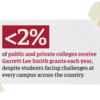
The Garrett Lee Smith program provides support that matters to these students. GLS campus grants support evidence-based mental health initiatives: screening and early intervention, peer support programs, crisis response infrastructure, faculty and staff training, and strong connections to community-based care. Congressional leaders recently acknowledged the importance of this program in last month’s bipartisan budget deal, which includes a modest increase for GLS campus grants to $10.48 million (from $8.48 million last year), rebuking the Trump Administration’s original budget proposals that would have zeroed out the program’s funding. While this new investment is critical, it remains vastly insufficient relative to the scale of need: less than two percent of public and private colleges receive GLS grants each year, despite students facing challenges at every campus across the country. And in a world where last year’s One Big Beautiful Bill Act cut $911 billion from the Medicaid program last year—over 82,000 times the amount of federal funding that GLS grants take up—colleges and students are facing extreme headwinds in finding and accessing reliable care.
Let’s be clear: these grants are not luxuries. They are often the backbone of campus mental health systems. They are critical for campus safety and student wellbeing. "Our two GLS Campus Suicide Prevention Grants allowed us to first develop and later enhance a suicide prevention infrastructure,” said Dr. Joe Behen, former Dean of the Wellness Center at School of the Art Institute of Chicago (SAIC). “The funding staffed new mental positions that were sustained by the institution, supported a range of mental health promotion and prevention activities that were integrated into our student support systems, and introduced us to necessary partners that complemented our internal resources and helped us to better meet student demand for mental health support and care. I have no doubt that our grant efforts have saved lives and enhanced the well being of countless students."
And yet, when I reached out to Dr. Behen—a leader and champion in the field whom I’ve had the honor of working with over the last two decades—to inquire about the status of their GLS grant, I learned that the university had eliminated the Dean of Wellness position a couple months ago amid broader financial challenges facing the institution.
This is the cruel irony of the current moment. Even when federal investments like GLS work exactly as intended—building effective, life-saving mental health infrastructure—those gains remain vulnerable within a higher education system under profound financial strain. Institutions are being asked to respond to escalating student needs while navigating budget shortfalls, enrollment volatility, the steady erosion of public investment, and attacks from the federal government.
The whiplash surrounding the thankfully averted cancellation of GLS grants underscores a larger truth: when mental health care is treated as discretionary rather than essential, campuses are left scrambling—and students pay the price.
These threats do not exist in a vacuum. They come on the heels of the Trump Administration ending support for federal Basic Needs Grants last year—which Congress also restored in last month’s spending package—and other vital supports that help campuses address food insecurity, housing instability, and transportation barriers. For students, the message is clear and devastating: when your mental health suffers because you can’t afford to eat, sleep safely, or access care, you’re on your own.
Cutting grants for basic needs, while disrupting federal benefits, and threatening mental health supports, creates an escalating cycle for students. Basic needs insecurity can lead to mental health challenges and mental health challenges can lead to basic needs insecurity. In fact, our research consistently shows that most students—a staggering 71%— facing mental health challenges also report precarity accessing food and housing. Cutting mental health funding while dismantling basic needs supports doesn’t just compound harm—it creates a vicious cycle that pushes students closer to crisis and farther from completion.
The immediate outcry and reversal of GLS and other grant terminations was a reminder that mental health is a bipartisan issue impacting all families. Mental health is not an ancillary student service. It is foundational infrastructure for learning. If policymakers are serious about preventing suicide and improving college completion, workforce readiness, and economic mobility, they must understand that mental health care is not optional. It is as essential as classrooms, financial aid, and accreditation.
At this moment of national turmoil, students deserve better than leaders who ask them to rely on resilience alone. They deserve care, stability, and durable structures designed to support their well-being—not policies that undermine it.